From ambition to AI impact
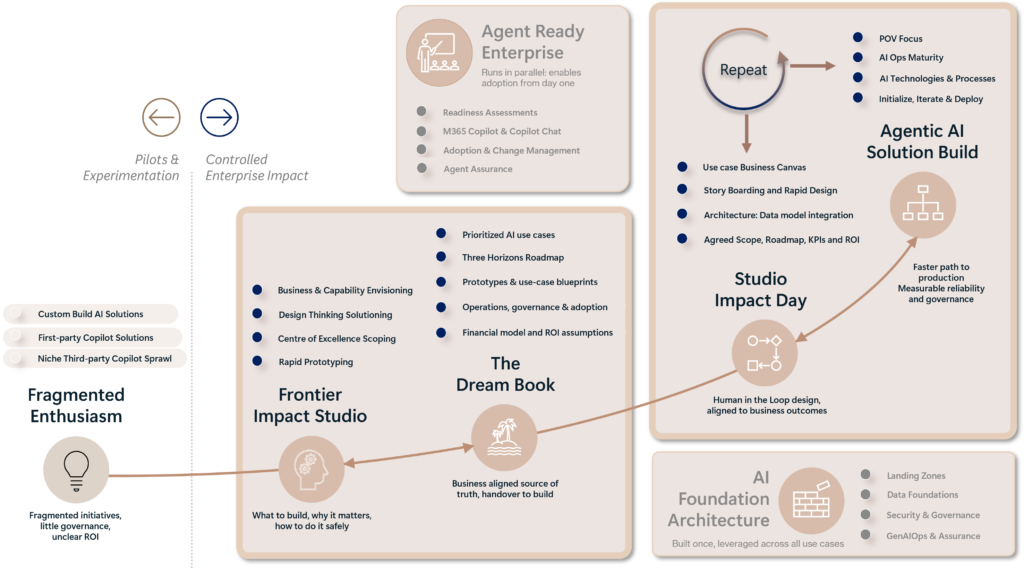
The Studio is how we work. It’s the approach behind every AI transformation we lead — three components, each with its own job, each unlocking the next.
One entry point. One handover. One build pattern.
Most AI engagements start with a tool and hope a strategy emerges. Ours start with a decision environment and end with a repeatable capability. The model has one entry point, one clean handover, and one build pattern that repeats for every use case that matters.
It moves an organisation along a single, deliberate path: from fragmented enthusiasm — scattered initiatives, little governance, unclear ROI — to controlled enterprise impact, where AI is a capability the business owns and compounds.
Don’t add AI to your roadmap. Rebuild the map around AI.
The most expensive AI mistake we see isn’t technical. It’s organisations treating AI as the next item on a roadmap built before AI existed — finish the CRM, modernise the estate, then think about AI. By the time they get there, the assumptions in the rest of the map are already wrong. Apps are changing shape. Data is changing what ‘good’ looks like. The roadmap rebuilt itself, but the organisation didn’t notice.
The Frontier Impact Studio is where leadership stops adding AI to old plans and starts building a new one. Two to four weeks, executive-led, decision-grade. It produces the Dream Book — the artefact every subsequent AI decision in your organisation gets measured against.
Inside the Studio: what AI is for in your business, who owns it, how risk is governed, which use cases come first, what the operating model has to change, and the first proof-of-value designed and ready to build.
Skip Decide, and the alternative is what we’ve named Zombie AI — programmes that look alive, consume investment, and produce no compounding return. Everything visible. Nothing connecting.
Roadmaps built before AI are roadmaps to the wrong place.
Laid down once. Used everywhere.
The Dream Book makes the decisions. Frontier Foundations makes them safe to act on at enterprise scale.
This is the engineering work most AI programmes underestimate — and the work that determines whether the agent estate becomes a capability or a liability. Identity. Data. Security. The Copilot estate. The agent management layer. The landing zones AI runs on. The Responsible AI guardrails that turn agent autonomy from exposure into asset.
It’s delivered by Cloud Direct’s engineering bench — twenty years of building Microsoft platforms for enterprises in regulated and unregulated industries. Patterns refined across hundreds of builds, applied to your environment.
Laid down once. Used everywhere. Every use case the Studio prioritises and every Build that follows runs on what Foundations laid down.
Skip it, and you don’t get a platform. You get a pilot. And pilots don’t compound.
Trust isn’t a feature you add. It’s a structural property of the system.
Turn proven thinking into running capability.
The Studio decides what to build. Foundations makes it safe to build. Frontier Build is where it actually gets built — at the pace and rhythm enterprise AI requires.
Frontier Build runs as a repeatable delivery cycle. Each cycle takes one prioritised use case from designed proof-of-value to production capability, in weeks not quarters, with the adoption work running alongside the technical work — not after it. Cycles start with an Impact Day. They end with a working capability the business owns and a metric that moved.
Each cycle leaves the platform stronger than it found it. Patterns reused. Integrations established. Governance pre-approved. The fifth cycle ships dramatically faster than the second.
This is what most AI programmes try to do by running more pilots. Pilots optimise for learning. Builds optimise for value in production. That’s the difference.
Most AI programmes scale by running more pilots. That’s why most don’t compound.
Adoption isn’t a phase. It runs through every component.
Most AI programmes treat adoption as a workstream — bolted on after the technology lands, with separate budget and separate ownership. That’s why most adoption fails.
We treat adoption as a discipline that runs through Decide, De-risk, and Scale — not alongside them. The Microsoft data is unambiguous: organisational factors drive twice the AI impact of individual mindset. 17 points of additional value when managers visibly use AI themselves. Only 13% of employees say they’re rewarded for the reinvention of work with AI.
Most ACM teams sell training. We sell system redesign.
Old ACM managed resistance. New releases it.
How it’s priced. Fixed fee, fixed scope, fixed duration.
No day rates. No scope creep. You know what you’re spending and what you’re getting before you start.
- A Frontier Impact Studio is £60K. Two to four weeks, executive-led, producing the Dream Book and the design of a first proof-of-value.
- A Frontier Build cycle is around £40K. A Studio Impact Day followed by iterative build to a working proof-of-value, ready to move into MVP and production.
- Frontier Foundations and production-grade builds are scoped per engagement. Most clients invest £150–300K across their first six months with us.
For commercial models that share outcome risk, see Aligned Delivery →.
Studio isn’t a toolkit, a deck, or a pilot factory.
A toolkit you buy and run yourself. A consulting engagement that ends with a deck. A platform play disguised as a strategy engagement. A pilot factory that produces interesting demos and no compounding return.
It’s an operating-model intervention, supported by the engineering depth to execute it, delivered against measurable enterprise outcomes.
Most clients start with Decide.
Almost everyone starts with Decide. It’s the smallest, fastest, lowest-risk engagement, and it produces the artefact — the Dream Book — that makes every subsequent decision better.
If you already know what AI is for and you’re stuck on the platform or the scale, we can start there. Most don’t.
Frontier Firms aren’t smarter. They’re better designed.