Scale: Frontier Build
Local wins don’t scale themselves. Frontier Build is how the work that succeeds in one part of the business becomes capability across the enterprise.
From decisions to production.
The Dream Book containing the Frontier Map hands Build a prioritised list of use cases, agents, workflows, integrations, each with an agreed business outcome, an owner, and an ROI hypothesis. This is not where strategy gets revisited. The decisions are made. Build is where they get delivered.
One cycle. Repeated. Compounding.
Each cycle takes one prioritised use case from designed idea to production capability, typically in weeks, not quarters, built around two principles: hard gates that kill bad use cases early, and shared Foundations that make every next cycle faster than the last.
it starts with an impact day.
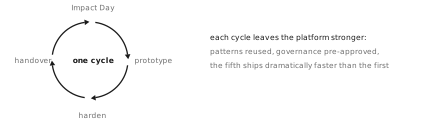
A focused working session that takes a use case from prioritised idea to designed solution: a one-page business canvas, a story-boarded design, the architecture and data integration, and agreed scope, KPIs and ROI. An Impact Day produces commitment, not a recommendation.
then the build moves to production.
Through deliberate gates: a working prototype to prove the value, hardening to production standards, then operational handover. Each gate asks a different question: does this work, will it survive production, can the business run it without us.
then the next Cycle.
Every cycle leaves the platform stronger. Patterns reused, integrations established, governance pre-approved. The fifth Impact Day ships dramatically faster than the first. This is what Microsoft’s 2026 research calls Owned Intelligence: institutional know-how that compounds, is unique to the firm, and hard to replicate.
What Build ships, on the estate you run.
Build lands on the Microsoft stack Foundations has prepared, and each case ships as the pattern its placement demands.
Assistants in the flow of work.
Copilot extended into your processes, grounded in your governed data, where the case asks for judgement support rather than autonomy.
Built agents.
Declarative and pro-code agents in Foundry and the Power Platform, with identity, evaluation and monitoring inherited from the assurance layer, where the case asks for work done end to end.
Orchestrations and integrations.
The workflow, data and system joins that let a case cross functional boundaries, built once as patterns and reused.
Human-in-the-loop by design.
Wherever the line analysis marked a judgement point, the handoff is engineered, not hoped for. The placement decides the pattern; the pattern is never the starting point.
Delivery protects how your people learn.
Where a case automates the work juniors build judgement on, the learning is replaced by design, structured supervision inside live delivery, before the automation ships, not after.
Build optimises for value in production.
A pilot asks “can this work”. A Build asks “how do we make this work, here, with measurable value, by this date”. A pilot ends with a recommendation; a Build ends with a capability in production and a metric that moved. A pilot resets every time; a Build compounds.
Most AI programmes scale by running more pilots. That’s why most don’t compound.
Fixed fee per cycle. Aligned to outcomes.
Per cycle, fixed fee. For organisations that want results tied to outcomes, three commercial models share delivery risk differently:
Impact-gated.
A portion of the fee in escrow until the success criteria are met.
Co-innovated.
Shared costs, shared access to anonymised patterns.
Value-shared.
We build at our expense; you pay a performance fee from the savings or revenue generated.
Built to hand over.
Around the fifth or sixth Impact Day the patterns are familiar, the infrastructure is doing its job, and the playbook is your playbook.
The point of the Studio is to stop needing the Studio.
Where is your line?
Twenty minutes, screen-share, a real readout end to end. No deck, no discovery call: the method shown working.