
The frontier line
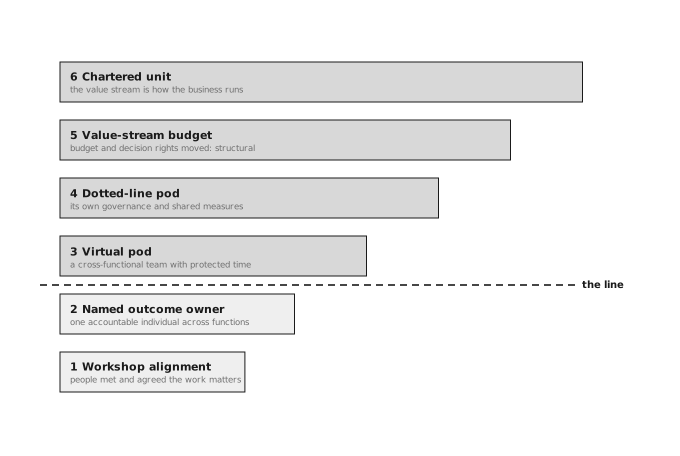
Your line is drawn from what actually happened to your last few cross-functional initiatives, rather than from what the status slides claimed.
The argument in one page.
Every serious firm is adopting agentic AI, and the technology is not the constraint: it is excellent and improving monthly. The constraint is what an organisation, its structures and its people, can absorb, own and run. Buying the platform while keeping the structure unchanged is how firms pay twice.
We call that constraint organisational load, and it lands at two levels: the firm, and its people. The Frontier Line measures both. Every case in a portfolio is read four ways: Horizon, when the value lands; Experience, twice, what the case gives customers and what it does to the people who do the work; and the Line, what the organisation must become to deliver and run it, on a six-level evidence-based ladder. The first reads are familiar territory done carefully. The Line is the measure everyone skips, and it is why three things shipped last year and the rest stalled.
One asset, four cases unlocked
From the white paper’s composite portfolio, a wealth firm running at level two. The client portal agent demands level two: deliverable now. KYC and AML automation and the suitability file check demand level three. Digital advice demands level four. Autonomous rebalancing demands level six, and was refused with the reasons on file. Then the finding that changed the sequence: five cases shared one missing thing, a standing compliance clearance route for AI-produced output. Building that single asset lowered all five by a level. Four became deliverable at once, conduct monitoring moved a level nearer, and nobody restructured anything.
What you actually get.
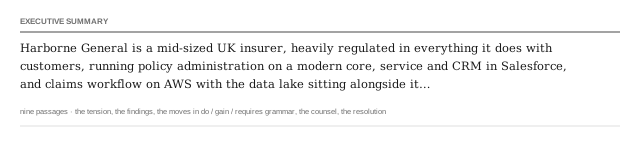
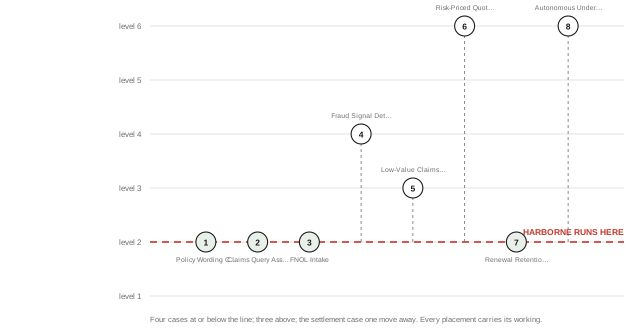
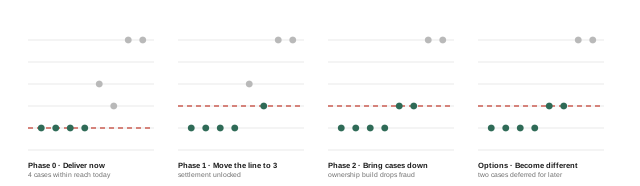
Below is a readout produced by the method, end to end, on Harborne General, a fictional mid-sized UK insurer built to be worked in public. Eight cases, every placement carrying its working, the warnings gathered in one view, the sequence with owners.
Where the method sits.
A diagnostic should know its place. The Frontier Line is the front door: it makes organisational load visible and turns a use-case list into a sequence of decisions. Once a case proceeds, the disciplines you already trust take over, and the method arrives at their door with the paperwork started. Governance frameworks (NIST AI RMF, ISO/IEC 42001) receive every case with an owner, an oversight posture and its gates already named. The product-operating-model discipline is not adjacent to the method: it is the upper half of the ladder, and “move the line up” is precisely the decision it exists to execute. Benefits realisation receives each case already typed by the return it claims: counted, proxied, or priced as a premium. The method feeds these disciplines; it replaces none of them.
The discipline that keeps it credible.
No invented numbers.
Where value can be counted, it is counted against a baseline named before the build. Where it cannot, the case runs to a proof of value with success and kill criteria written before it starts. A pilot is a build with the hope left in; a proof states in advance what would prove it wrong.
Tested like an instrument.
Every classifier that places a case is stability-tested; placements carry confidence, and their driving evidence is on screen and challengeable. A successful challenge recomputes the placement, it does not annotate it.
A defensible no.
The method produces “do not build this” as readily as “build this now”, and the worked readout contains both. That is what makes the yes worth funding.
Read the whole argument.
The white paper carries the full method: the models behind it and their lineage, the worked portfolio, the reliability protocol, and the rubric. Twenty-five pages, written to be argued with.
Where is your line?
Twenty minutes, screen-share, a real readout end to end. No deck, no discovery call: the method shown working.